Monday, January 29, 2007

3rd Week: OK, brace yourselves...

The BBC News website reports on the story that's going to be everywhere in the world tomorrow: Windoze Vista's launch. Luckily for my sanity, they've avoided (so far) the Redmond whitewash by inviting proponents of the other two members of the Big Three OSs to give their pitch alongside two pro-Microsoft folk.


We can all but discard the first pro-Windows comment, obviously from someone who's never seen anything but Windows first-hand and focuses almost entirely on eyecandy (nothing wrong with an OS having eyecandy - but when you're paying £170 minimum (or £80 for an upgrade), it can't be the only thing going for it).


The second pro-Windows comment is more substantial, so I'll grab a few quotes and deal with them in turn, occasionally sarcastically.


A huge amount of research has been put into this new version which is evident in everything from the user interface right through to the new security model.
This would be the 20+ people it took to design the shoddy "shut down" options menu? And the new security model based on the philosophy of "annoy the hell out of everyone so they turn it off" (as instantiated by my technically-adept contemporary MSHV). You can't really defend against users with the mindset of "click OK just to get rid of the damn things", mind (hence why not everyone is cut out to be a superuser - don't take the name of root in vain).

This latest update provides many new components but the one which will provide the greatest change for windows users is the Windows Presentation Foundation - a set of components which allow graphics designers to produce visually stunning user interfaces.
I have to say, I wasn't blown away when I first saw Aero (I know - "Linux fanboy!!!!111") but I can't deny that it looks... nice. It's certainly a big improvement over XP's default Fisher Price settings. And I suppose the big difference here between Windows (and Mac for that matter) and Linux systems is choice, or lack thereof. A Windows developer making a GUI application is almost certainly using Visual Studio, and (for Vista) will be using WPF to make their app look and feel like every other Windows app - like it's part of the system.


Linux is different. Not only are there two competing desktop environments in KDE and Gnome (yes, there are more than this, but these are the big two) but the way they draw elements like buttons, scrollbars etc is different from the ground up. KDE uses the Qt toolkit, while Gnome uses the GTK one. Somehow, I get the feeling whenever I use an app designed for GTK, that it's not quite looking how it should - and while integration with KDE themes is there, it's not watertight. It doesn't (usually) affect the functionality of the app, just the look and feel. Oh, dear, we're talking eyecandy again...

I also like the way that all my existing hardware just works (although I am aware many other people have had problems).

Well, at this point I could give the usual "if-more-people-used-Linux-more-hardware-people-would-release-drivers-for-it" spiel but I won't. Fact is, I think of the Big Three, Linux has the absolute widest hardware support of the lot. Vista only seems available on x86 and x86_64 processors... no SPARC, no PPC... Ever tried to find drivers for an old printer on XP? Chances are it'll be already waiting for you in Linux. Reading through the list of drivers in the Linux kernel sources is a mammoth task - but, of course, we can't compare it since OS X and Vista are closed-source. Apple OSs, it's worth pointing out, only ever come with Apple-built hardware and are only designed for Apple machines, so Apple loses the hardware compatibility race from the off.


So we get to the Linux-user's comments (interesting that the Beeb would put Linux above Apple in the article). And going through this closely... I can't really fault it. It makes all the right points (though it does only dedicate two lines to eyecandy... shock horror). It doesn't make a big song and dance about being completely free; it doesn't deny the weak points (as the other three comments do - any OS will have weak points!); and it does briefly discuss the fact that the whole ethos behind Linux as an open-source project is a different one to that behind Windows and OS X:

What really sets Linux apart is its social significance provided by the free software license. It encourages users to share the software they love with their friends, rather than making the act of sharing illegal and branding it piracy.


Also it encourages programmers to be better people, working in the open and allowing other programmers from across the world to help improve their software, rather than locking up their work with restrictive licences which prevent programmers from working together.


So to the Mac-user... and I have to admit, I have too little experience of Mac OS to be able to raise many comments. Most of the points he raises - security, maintenance, productivity and interoperability with Windows users - could equally be applied to Linux too.

I now feel like I am in charge of my computer rather than it being in charge of me.

And yet you can still only do things that Apple let you do, Mr. Tilney. You only own a license to the OS, not the software itself... and still, you're tied to the Apple hardware+software+soul combination.


My bottom line? I think it's been well-stated elsewhere that I'm a Linux user through choice, and see no reason to go back to Windows. Sure, I keep it around for the odd spot of gaming (or playing Lucy at MSN Games into the early hours) but would I ever use it as my primary OS again? Not through choice. And, let's not forget, that both Apple's OS and Vista are defective by design, and include software "features" to limit your freedoms with digital media. But when the Penguin sets you free, you will be truly free... ;-)


Technorati Tags: , ,

Monday, January 15, 2007

1st Week: Hooray for Kingsway

Kingsway are offering individual song downloads for 99p each - and, more importantly, the downloads are MP3s and without any Digital Restrictions Management. I've just bought a copy of Matt Redman's "Never Let Go" - we sang this at St. Aldate's last night and right now it's just so spot-on for describing my life.


Even though I walk through the valley of the shadow of death,

I will fear no evil,

for you are with me;

your rod and your staff,

they comfort me.

(Psalm 23: 4)

Sunday, January 14, 2007

1st Week: A Copied Quiz Thing - Soundtrack To My Life

I never ever do these things, but I'm doing this one because a) I haven't posted on this blog for nearly two months, b) it's quite a good one as it gives you an insight into a person's music collection, c) I'm bored, and d) it's one more thing to distract myself from everything that's happened in said last two months, if only temporarily...

IF YOUR LIFE WAS A MOVIE, WHAT WOULD THE SOUNDTRACK BE?
So, here's how it works:
1. Open your library (iTunes, Winamp, Media Player, iPod, etc)
2. Put it on shuffle
3. Press play
4. For every question, type the song that's playing
5. When you go to a new question, press the next button
6. Don't lie and try to pretend you're cool..


Opening Credits:
Pink Floyd - Shine On You Crazy Diamond

Waking Up:
Mr. Mister - Welcome To The Real World

First Day At School:
Pink Floyd - Is There Anybody Out There?

Falling In Love:
Delirious? - Message Of The Cross

Breaking Up:
Star Wars VI soundtrack - Ew*k Celebration and Finale (now there's irony)

Prom:
A few bars of the BBC News theme... don't ask why

Life's Ok:
Delirious? - Solid Rock

Mental Breakdown:
Fight, Win, Prevail (from the soundtrack to Command & Conquer: Tiberian Dawn)

Driving:
Delirious? - Now Is The Time

Flashback:
Phatfish - There Is A Day

Getting Back Together:
(Мне все еще жаль, что это не может случиться, with apologies for the translation)
Matt Redman - King Of This Heart

Birth of Child:
Delirious? - I Was Blind

Wedding Scene:
The Itchy and Scratchy theme from The Simpsons (again, don't ask why)

Final Battle:
Tim Hughes - Jesus You Alone

Death Scene:
Sean Callery - LA At 9:00AM (from the 24 soundtrack)

Funeral Song:
Spring Harvest - How Great Is Our God (ironically enough, I hope this will genuinely be at my funeral...)

End Credits:
Pink Floyd - Comfortably Numb

So what have we learned? Well, that my collection contains a lot of weird clips of television themes; that Ew*ks and the Rebellion are ultimately responsible for the events of the last two months; that a recurring theme of my life has been, and will be, Jesus; and that right now, I may not be comfortable, but I've certainly been feeling numb.

Saturday, November 25, 2006

7th Week: on the Facebook Development Platform

There seems to have been a lot of controversy of late surrounding the mysterious and seemingly-misunderstood Facebook Development Platform. Is this a secret plan to sell your personal data to the highest bidder? Is it some way for people to view and steal your profile information? (For those who don't know, Facebook is one of these social networking sites - you know, the "I've got 17 more friends than you" type places. It's a complete waste of time, but (or possibly therefore) is brilliant.)

Let's look at what the FDP actually is. Above all things, it is for developers - computer geeks like me who like to write programs, and would like to integrate them with Facebook.

Here's a note that I found someone had posted:
Hey Kids, So apparently Facebook has started SELLING user information (surprise, surprise!) to third parties. They call it the "Facebook Development Platform." To restrict use of your information, do the following...
The same note goes on to make up "quotes" from the Facebook Terms of Service and Privacy Policy (Really! Go and look yourself, if you've seen the original note!). Facebook's own FAQ deals with this issue directly:
Facebook respects your privacy. We don't distribute your user information to marketers or spammers. We also do not allow crawlers from search engines on our site.
In fact, far from selling information, the FDP is free to make use of - anyone on Facebook can sign up and make use of the API in their own applications. The important point to make about this is that, in order to use applications that use the Facebook API and access any information, the user needs to log in to Facebook. At no point do they gain access to information they couldn't have gathered from the Facebook site.

The issue was raised again about an hour ago, when a friend of mine invited me to join the group "People Radar is an abuse of information on Facebook". People Radar, recently renamed from FaceRadar (because Facebook apparently own the copyright to the word "face"), is one of the myriad applications that make use of the Development Platform and its API. The basic premise of the site is: you go through and rate members of your preferred sex on how "hot" they are. You can also check your own rating (for some reason, mine seems to be 1. Maybe an overflow error?).

While I in no way think that this is a particularly brilliant idea (far from it), I disagree with the group's statement that it is an "abuse of information". Facebook is a site designed for sharing information. Any information you put up, you expect to be shared - and FB duly gives you control over how this information is shared.

The group also suggests changing your privacy settings to prevent your data being used for the FDP. This, though, is rather like using a nuclear warhead to kill an ant (Note to any American President reading: this is a Bad Idea). PeopleRadar itself has an opt-out, and I would recommend that instead of the kill-all approach. If everyone took this route, then some genuinely interesting, some intriguing, and maybe even some genuinely useful ideas would be rendered useless. (An extensive list is available.)

As a developer, I say that would be a shame.

Wednesday, November 01, 2006

4th Week: The Legendary St. John's Fireworks

...were slightly disappointing this year.

Maybe it was the hype I was desperately trying to inject into the evening; recounting countless tales of previous SJC fireworks displays, from when they set fire to one of the trees encircling the Great Lawn, to last year's near-horizontal firework launch towards the crowd. Perhaps it was the fact that (mostly to prevent a re-occurrence of the aforementioned) a professional was called in. I mean, who wears a helmet when putting on a fireworks display? Perhaps it was the final two fireworks: Wheeeeeeeeee.... put. put.

Or maybe it's the fact I got to bed at about 3.15am last night...

Sunday, October 29, 2006

4th Week: About Time

BBC News has early coverage of a report, due out later today, with the Institute of Public Policy Research's report into a review of copyright laws. Read it at http://news.bbc.co.uk/1/hi/uk/6095612.stm.

From the article:
Copyright laws are "out of date" and must be updated so MP3 player users can make copies of CDs without breaking the law, according to a think tank.
Yes! That's exactly right! And, my favourite quote of them all:
It is not the music industry's job to decide what rights consumers have. That is the job of government.

Saturday, October 28, 2006

3rd Week: Good news from the world of broadcasting

At long last, BBC Parliament will be available in full screen format on Freeview from November 13, reports Digital Spy. (See the official BBC press release here.)

Unlike satellite and cable TV, Freeview has only a limited bandwidth available; there's a limit to the number of channels that can be broadcast. Until now, BBC Parliament has been broadcast quarter-screen, in the same video stream as the two News Multiscreen video loops; on both, MHEG text screens cover the other side of the screen.

With Parliament now in full-screen, this either means the end of News Multiscreen on Freeview, or else enough room for a few more screens. Or perhaps they've managed to squeeze out an extra channel's bandwidth by reducing the quality of the others (BBC Four/CBeebies, 301/302) But which is it to be?

The discussion of this has spread to eight pages on the DS forums...

Thursday, October 26, 2006

Tuesday, October 24, 2006

3rd Week: Food for thought for Linux geeks

This was written in July, but I've only just found it. Written by A Y Siu (a name I recognise from the Kubuntu forums, as it happens), it debunks the myth of "the year of the Linux desktop", while simultaneously destroying the myth that "Linux is not ready for the desktop". An interesting read...

http://www.psychocats.net/essays/linuxdesktopmyth

Essential reading for anyone waiting for Linux to break through into the mainstream; and for anyone who's heard of Linux, has maybe been told that it's better than Windows (by some Linux geek like me).

Saturday, October 21, 2006

2nd Week: Latest Pictures - Anti-Lab Protest

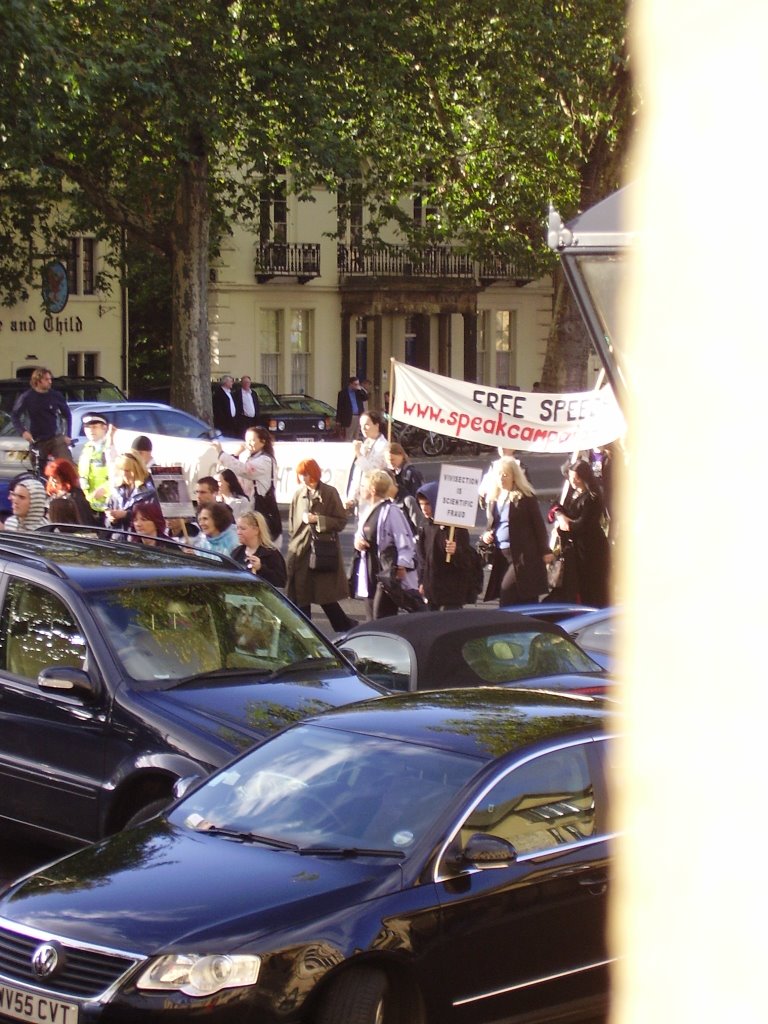
These were the best shots I could get of the anti-lab brigade (it's no longer sufficient to call them "protesters" thanks to Pro-Test, which causes confusion) - I really didn't want to hang out of my (ground floor) window as the protesters marched past, waving a camera, in case one of the ALF decided to make good their arson threat. Anyway, here are the photos.

The banner reads "FREE SPEECH" and has a website address. I'm not going to link to it. :-P


There were quite a few of them - they took a full four minutes to pass by outside.

And finally they depart... many of them seem to be holding banners saying "REMEMBER GEORGE". Unfortunately, I don't, though apparently he's a miserable-looking chimp. (Because there are so many chimps being experimented on in the new lab.) Also, some people were carrying banners saying "SUPPORT SCIENTIFIC RESEARCH - STOP VIVISECTION" or something similar. These people are, presumably, either confused or misled. I'm a Computer Scientist. The argument that "computers can do simulations so we don't need real animals" doesn't wash with me.

Friday, October 20, 2006

2nd Week: OCaml

How to make the ML programming language, for beginners.
  1. Take all the worst parts of Haskell.
  2. Make all those Haskell error messages even more obscure.
  3. Add in the noisiness of Oberon.
  4. Provide contradictory documentation.
I have no idea what I wrote but, after 90 minutes of fiddling around with punctuation marks, the practical works.

2nd Week: MythTV Database Issues

OK, for the second time in my life I had to scour the internet for the solution to a problem with a new installation of MythTV (from CVS). I'm putting this here so I can find it again in future!

If you try and run mythfrontend or mythtv-setup and get errors such as the following:

QSqlDatabase: QMYSQL3 driver not loaded
QSqlDatabase: available drivers:
2006-10-20 11:14:52.435 New DB connection, total: 1
2006-10-20 11:14:52.436 Unable to connect to database!
2006-10-20 11:14:52.437 No error type from QSqlError? Strange...
QSqlQuery::exec: database not open
2006-10-20 11:14:52.496 DB Error (KickDatabase):
Query was:
SELECT NULL;
No error type from QSqlError? Strange...
2006-10-20 11:14:52.572 Unable to connect to database!
2006-10-20 11:14:52.573 No error type from QSqlError? Strange...

... then the solution is twofold. Firstly make sure you have the Qt MySQL drivers installed (Ubuntu people: that's libqt3-mt-mysql). Secondly - and this is the bit that always takes ages to find... You need an /etc/ld/so.conf file that contains the path to the said driver. Ubuntu people: /usr/local/lib.

That's it. That's what takes hours to solve. Not any more.

Friday, October 13, 2006

1st Week: Help! Help! We're being repressed!

TechWeb reports on the licenses for Microsoft Windows Vista, due out... well, some time. So just how much will you "own" of Vista, should you buy it?

Well, of course the answer to that is "none", and has been for some time thanks to the barely-legal End User License Agreement ("this software is licensed, not sold", among other things). As an end-user, though, Microsoft are trying very hard to control what do with their new baby.

Ever upgraded a computer, ditched the old one and installed Windows on the new one? You can now only do that once. Says the license:
The first user of the software may reassign the license to another device one time. If you reassign the license, that other device becomes the "licensed device".
Interestingly enough, this sort of limitation seems to be illegal, at least in America. In 2001, in a case between Adobe and SoftMan, the judge ruled that
...the terms of the Adobe EULA at issue prohibit licensees from transferring or assigning any individual Adobe product that was originally distributed as part of a Collection unless it is transferred with all the software in the original Collection. This license provision conflicts with the first sale doctrine in copyright law, which gives the owner of a particular copy of a copyrighted work the right to dispose of that copy without the permission of the copyright owner.
More coverage of that story was at Linux Weekly News and The Register.

It gets better, though it might take some explaining. Unless you're a techie yourself, then the following might go right over your head:
You may not use the software installed on the licensed device within a virtual (or otherwise emulated) hardware system.

"Virtual machines" or VMs are, as computers become more powerful, becoming more popular. Tools like VMware allow you to run an operating system within an operating system. You can boot into Windows, then boot up a Linux VM, and run both operating systems simultaneously. As well as being useful for developers, who need to test their products on a variety of different platforms, it has benefits for home users: Why worry about spyware and viruses when surfing the web, when you can load a VM with a browser, use that, and once you're done you can restore it to its initial state (including getting rid of stored personal data etc).

None of which violates the new EULA, as long as Vista is the "host" (that is, the real) operating system. Where this gets interesting is when you look to the developments that both Intel and AMD are making in the field of virtualisation. It's easiest to explain with reference to a diagram, so here's one from a presentation "Xen and the Art of Virtualisation":
What this shows is four different operating systems, running each as if they were the host OS, thanks to the Xen layer. Microsoft's EULA stamps all over this party (though it should be said, the same restrictions do not apply to the more expensive and undoubtedly more bloated versions of Vista, just Home Basic and Home Premium).

Oh - and if Vista decides to believe you've got a pirated copy of it, whether you have or not, it will severely limit your use of the OS and your computer. If you're one of the law-abiding people who buy Vista in the shops, you could find it not letting you use the internet, other than Internet Explorer for one hour at a time (gah, it's like my parents!).

Think you're safe with a genuine copy? Past experience tells us otherwise, as this article reports.
Scrolling through the posts on Microsoft's official WGA Validation Problems forum is like reading accident reports from a multiple-car pileup on Interstate 5. Many of the victims are completely innocent and have no idea what hit them, and cleaning up the mess can be a nightmare.

If you're a Windows user, and/or planning to upgrade to Vista if/when it is released, that should send a shiver down your spine. You have been warned...

Thursday, October 12, 2006

1st Week: A Conversation with Mel

This had me in fits of laughter for whole minutes at a time...

(13:11:31) Mel: dude
(13:11:44) Mel: were's te ceapest place I ca get a ew keyaord, do you tik?
...
(13:12:26) Mel: it's gettig aoyig ow
(13:12:31) Mel: it was oly oe letter yesterday
(13:12:42) Mel: ow it's 3
...
(13:15:40) Mel: aaaaa
(13:15:53) Mel: (tat was laugig witout cocosats)
... We then proceeded to almost order a keyboard from ebuyer, before realising that they would only ship to my billing address (Portsmouth) for my first order...
(13:39:02) Mel: or I could use my ousemate's!
(13:39:14) Mel: wy did't tat occur to me efore
...
(13:43:31) Mel: I've lost te questio mark as well ow
(13:43:50) Mel: sad

This, folks, is the sort of weird thing that happens in Oxford.

Tuesday, October 10, 2006

1st Week: Famous people! Questions! And a textbook

Slashdot reports on Jarosław "sztywny" Rzeszótko's E-mail interview with some of the greats in the computing world, including Linux creator Linus Torvalds and C++ creator Bjarne Stroustrup. It's a very good read; here are my personal highlights...

- What do you think is the most important skill every programmer should possess?

Linus Torvalds:

It’s a thing I call "taste".

I tend to judge the people I work with not by how proficient they are: some people can churn out a _lot_ of code, but more by how they react to other peoples code, and then obviously by what their own code _looks_ like, and what approaches they chose. That tells me whether they have "good taste" or not, and the thing is, a person without "good taste" often is not very good at judging other peoples code, but his own code often ends up not being wonderfully good.

- Do you think mathematics and/or physics are an important skill for a programmer? Why?

Tim Bray (co-author of XML and ATOM specs):

In my case, I’ve almost never used my university-level math to support my programming.

- What is your favourite book related to computer programming?

Linus Torvalds:
I have a soft spot for Andrew Tanenbaum’s "Operating Systems: Design and Implementation". (This is on my reading list for next term! Good to know it has pedigree...)

Go, read the rest for yourself - and tell me if it was worth me doing all that Maths last year...

Saturday, October 07, 2006

0th Week: Customer Service

How's this for customer service...
I buy a secondhand book online from abebooks.com its Java In A Nutshell Deluxe Edition which is supposed to come with a CD. It didn't, and the book's been out of print for quite a while now.

One short E-mail to O'Reilly (the publisher), and a few days later I have a brand-new CD on my desk. Two thumbs up, O'Reilly!

0th Week: Tired!

Wow, I'm tired... I got to bed at 3am after the St. Aldate's half-night of prayer; Dave and I were both on the A/V team  for much of the evening, though we were able to take it in shifts. It was a really encouraging evening, and one that made me really feel (almost) as at home here as at my home church. I even got to use my nice Risky semi-transparent stuff (I think it's fast becoming my signature piece, quite worryingly). It's little touches like that that make the difference.

So, got in about 2.40, and really fancied a cheese toastie. Bed about 3, but (surprisingly, as I was exhausted) found it really difficult to get to sleep. Woke up about 11, and I should probably get dressed somewhen soon...

My ridiculously busy Freshers' Week continues... it's the SJC Freshers' Fair, and OICCU Churches Fair, both this afternoon. I'm sure Freshers' Week wasn't this busy last year... I'd better get dressed somewhen soon. And do some laundry. And find some lunch. And so on.

Edit: This blog has been going for a year yesterday! Go me!

Thursday, October 05, 2006

0th Week: Freshers' Fair

I helped out with the CompSoc stall at the OUSU Freshers' Fair this afternoon. Gave out some free Ubuntu CDs, and had a long chat with some of the guys on the Toshiba stall about Linux.

I'm really, really tempted to buy a laptop...

Tuesday, October 03, 2006

0th Week: Consumer Warning

Please read this consumer warning. This stuff really exists and you should know about it. Please also pass this onto anyone else who may not be aware of what DRM is.

Warning: DRM! Digital Restrictions Management

This holiday season when you bring home a new electronic device, will you be bringing an intruder into your home? Will you and your family members end up being monitored and reported on by the software installed on these devices?

DRM is used to restrict what you and your family can do with the electronic devices and media purchased. It is an attempt by technology and media companies to take away your rights. DRM Means: No fair use. No purchase and resell. No private copies. No sharing. No backup. No swapping. No mix tapes. No privacy. No commons. No control over our computers. No control over our electronic devices.

DRM software and hardware monitors and controls your family's behavior.

Did you know that iPod users are restricted from transferring their music to other non-Apple devices because the music downloaded from iTunes is encrypted - locked with DRM? Apple allows you to write an audio CD, but will leave you with very lousy sound quality if you ever want to take your music to a new portable device in a compressed format.

Did you know that Sony Music was caught secretly planting DRM “rootkits” on customers computers. All it required was for you to play the CD you had purchased from them...

DRM is more than a nuisance. The film and music industry are setting the agenda to increase their control. They have demanded that technology companies impose DRM to deliver for them what their political lobbying to change copyright law never has: they aim to turn every interaction with a published work into a transaction, abolishing fair use and the commons, and making copyright last forever. By accepting DRM users unwittingly surrender their rights and invite a deeper surveillance. This will put your family's viewing, listening, reading, browsing records on file with them.

What gives them that right?

Stay away from DRM-dependent products like Blu-ray and HD-DVD, iTunes, Windows Media Player, Zune, Amazon Unbox...

Stay away from retailers who insist on making DRM part of the package.

Stop financing the people who want to restrict you.

Find out more at www.DefectiveByDesign.org and find 10 easy ways you can help make others aware.

Thanks for reading.

Monday, October 02, 2006

0th Week: Every TINYINT Helps

Tesco are to launch their own-branded software, reports the BBC.

This new range, to be launched later this month, includes office software, "security systems" (presumably antivirus and firewall), photo editing, and a CD/DVD burning suite. Now, this is an interesting move... From the report:
"When it comes to software there is little choice and prices are high. Our new range of software changes this, bringing choice and value to the market that has offered little of either for too long." -- Tesco buyer Daniel Cook

I have no doubt that these aren't the real motives for the venture - rather, increased profits and market share are, quite understandably. But it struck me just how close the stated reasons are to those of the free/OSS movement. Providing choice in a market that's offered little? As for value, you don't get much better than free (as in beer).

Of course, Tesco haven't hired a vast army of programmers for this; rather, they've signed an agreement with Formjet PLC, which gives a clue as to exactly what sort of products we'll be buying with our cornflakes. (Don't delve too deeply on their website, though, or you'll end up with lots of "Untitled Document"s.)

Could this be a big blow for OSS in the UK? With cheap software available from the UK's leading supermarket, will fewer people turn to free alternatives like OpenOffice? Or will it make people realise that not all software is made in Redmond, and start looking for alternatives?

Tesco's software range launches in late October in about 100 stores.